
When travelling, the usual way is to carry sufficient cash for the trip — either bring more to prevent running out of cash or bring not enough resulting in having to borrow after overspending. The downside of carrying too much cash on trips is the uneasiness and risks of losing the money. As such, cashless payment has become a modern trend — but only in regions that have the infrastructures to support it.
Malaysia comprises of West Malaysia (or Peninsula Malaysia) and East Malaysia (Borneo Malaysia) with large areas of forested, mountainous lands and also smaller, poorer towns, which lack the infrastructures to support cashless payment. Furthermore, payment technologies come with implementation costs, which many smaller vendors are unwilling to bear. For convenience, travellers often have to rely on multiple payment methods, instead of carrying large amounts of cash and risk being targets of crime.
Listed in this article are common payment methods that can be used when travelling in Malaysia. We will also compare the exchange rates of the methods, where applicable.
Contents:
1. Cash
“Cash is king” is a phrase that we often hear when it comes to payment. Despite advance technologies that support cashless payments, cash is still the most basic form of payment in many places and also as fallback when all means of cashless payment failed or are not accepted — “advance technology” is not free and cannot function without electricity and the Internet.
In Malaysia, there are still a lot of small vendors, private transport providers, small businesses in rural areas, etc, that does not support cashless payments — or unwilling to support them due to high costs of implementation. Thus, cash is still required in such situations.
In advanced cities / towns in Malaysia, the preferred way will be to carry less cash (as contingency) and use cashless means to make payments whenever possible. When travelling to less-advanced or rural areas, especially in forested, mountainous regions or smaller towns, it will be best to carry sufficient cash.
2. Credit / Debit Cards
International credit / debit cards have been the de facto means to make cashless payments when travelling overseas and cards like Visa, Mastercard, UnionPay, etc, are widely accepted in Malaysia. Amex may be accepted at larger establishments but not as widely as the others.
The use of credit / debit cards is limited to larger or more established businesses due to high costs of implementation. Some merchants may require minimum purchase amounts before accepting such cards. Thus, credit / debit cards have limited use among smaller, local merchants, which constitute the vast majority in Malaysia.
Physical credit / debit cards, and contactless equivalent on NFC-enabled devices, can also be used to pay for fares onboard public buses in major cities.
Key Points:
- For debit cards, top-up linked e-wallet with adequate amount for short-term use and avoid using automatic direct debits from bank accounts.
- Cash withdrawals from local ATMs using credit cards are “cash advances” and subject to higher interest rates and applicable fees.
- Cash withdrawals from local ATMs using debit cards deduct amounts from applicable accounts directly / via e-wallets and may subject to prevailing exchange rates (if conversions are required) and applicable fees.
- Credit / debit cards are susceptible to theft and misuse, so do enable PayWave for tap-to-pay and avoid letting the card out of sight.
- Exchange rates of transactions are determined by card issuers. However, the rates of issuing banks / financial institutes, plus fees charged by Visa / Mastercard, tend to be poorer than rates offered by money changers.
3. YouTrip (Debit Card)
YouTrip is a Singapore-based prepaid debit card service, tied to an e-wallet, that has became very popular among travellers from Singapore. With a multi-currency e-wallet, and powered by Mastercard, YouTrip is useful for travel use and works like a credit card. As a debit-only service, the e-wallet needs to be topped up with funds before payments can be made. The key benefit of using YouTrip is its better exchange rates over banks, money changers and many other applications.
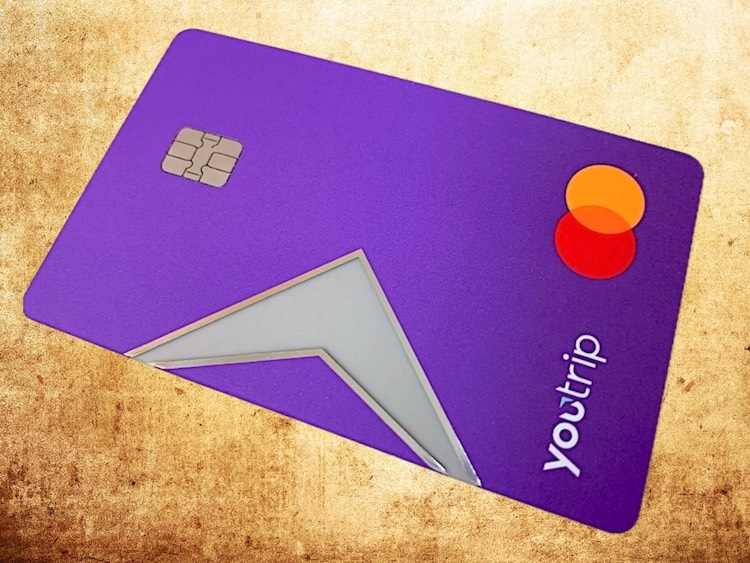
YouTrip supports currency conversion for Malaysia Ringgit (MYR) and stores it in the e-wallet for direct debits when making payments in MYR.
Powered by Mastercard, YouTrip can also be used on cross-border Causeway Link bus services and most public buses in Johor Bahru, Malacca, and other major cities, either via tapping using physical card or contactless through NFC-enabled mobile devices. MYR funds in the eWallet can also be withdrawn from ATMs as cash — preferably with no transaction fees.
More: Singapore Tip: Use YouTrip for Cashless Payments Overseas
4. Changi Pay
Integrated into Singapore’s Changi App, Changi Pay is a digital wallet that facilitates cashless payment at Changi Airport and Jewel Changi, as well as globally via the Alipay+ payment network. The e-wallet allows Singapore residents to top-up funds via PayNow for seamless QR code payments in participating countries.
More: Singapore Tip: Use Changi Pay for Cross-Border Cashless Payment
Riding on the Alipay+ network, Changi Pay can be used to make payment at retailers in Malaysia bearing the Alipay+ QR codes. Payment by Changi Pay will not incur any transaction fees. Alipay may also dish out random discounts at times, resulting in cheaper purchases.
Aside from Changi Pay for Singapore residents, other Singapore-based apps that ride on the Alipay+ network include ShopeePay, GrabPay and OCBC Digital (for OCBC customers). However, overseas payments using ShopeePay and GrabPay may incur transaction fees above the exchange rates determined by Alipay+.
See also: Full List of Alipay+ Mobile Payment Providers
5. PayNow-DuitNow Transfer
PayNow is a Singapore-based real-time inter-bank payment system whereas DuitNow is Malaysia-based.
The PayNow-DuitNow linkage allows person-to-person (P2P) fund transfers between Singapore and Malaysia, requiring only the recipient’s mobile number or Virtual Payment Address (VPA). This method of payment is useful if the merchant (small business, hawker stall, night market vendor, etc) uses his/her own mobile number to accept payments.
Any Singapore banks’ payment apps that support PayNow will be able to utilise the PayNow-DuitNow Transfer within the apps. Exchange rates of transfers are determined by respective banks.
6. DBS PayLah! / Payment Apps by Banks
Most payment apps by Singapore banks and private providers, such as ShopeePay, Alipay, WeChat Pay, etc, can be used to make payments in retail outlets in Malaysia that use the DuitNow (pronounced as “do it now”) QR codes. Using these apps to scan-and-pay in Malaysia are the same as using them in Singapore to make payments.
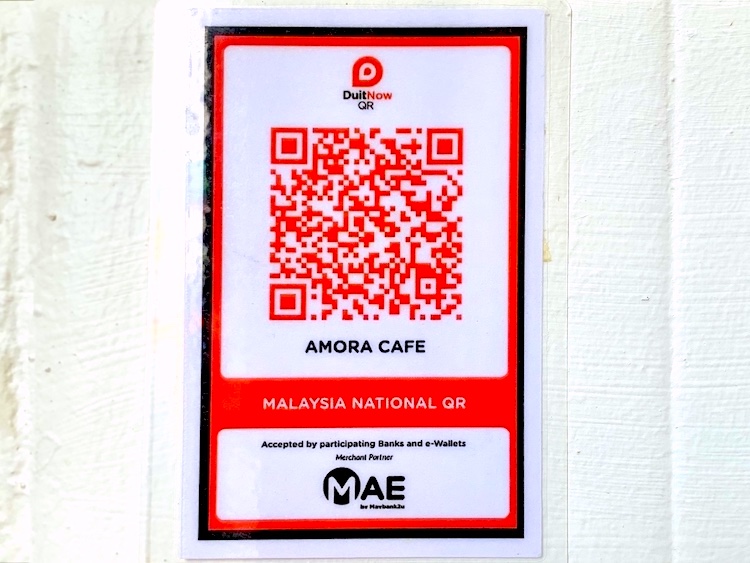
Since I use DBS PayLah!, I will use it as an example. PayLah! has an additional feature when paying in Malaysia: it will do a conversion of the ringgit amount to SGD at the same time and show the equivalent in SGD before confirming payment.
Note: The DuitNow QR must be a static merchant code, which is usually pre-printed and displayed at the counter. DuitNow QR codes that are generated on a merchant’s Point-Of-Sale (POS) device with the payment amount is probably a transaction code and is not recognised by DBS PayLah!.
More: Singapore Tip: Use DBS PayLah! for Cashless Payment in Malaysia
Since the payment services are provided by banks, or other private providers, the exchange rate may be poorer. However, the difference can be insignificant considering the convenience they bring — especially for infrequent travellers on day trip / short trip to Malaysia.
7. Touch ‘n Go
Touch ‘n Go (TNG) is a contactless smart card system for cashless payments in Malaysia. It is widely used by the Malaysian government, especially the Ministry of Transport (Malaysia). Drivers in Malaysia need to use Touch ‘n Go to pay road-related charges, such as tolls, vehicle entry permit, etc. Many transport hubs in Malaysia are going cashless, accepting credit / debit cards and TNG only. However, TNG cannot be used to pay for bus fares onboard stage buses, which have their own payment systems.
Many merchants in Malaysia prefers to use TNG — and cash — for payments by displaying a blue TNG QR code and may not support DuitNow QR nor accept credit / debit cards. In such cases, other than using cash, TNG becomes handy. Scan-and-pay using TNG QR code is via TNG eWallet only whereas tapping on NFC payment readers (if available) can be via TNG card or TNG eWallet.
Note: Touch ‘n Go card and Touch ‘n Go eWallet are two separate entities. Using a TNG card to make payment does not deduct any amount from the TNG eWallet, and vice versa.
Touch n’ Go cards can be purchased from supporting outlets and convenience stores. There are two types of card: a normal card and an enhanced card that supports Near-Field Communication (NFC). Both cards cost RM10 each. There is a (hidden) surcharge of another RM10 for each purchase of the card — I paid RM30 for an enhanced card with RM10 credits and validity of 6 years.
Topping-up the cards can be done at any physical TNG stations at supporting outlets. The enhanced TNG card supports top-up from TNG eWallet on a mobile device with NFC capability.
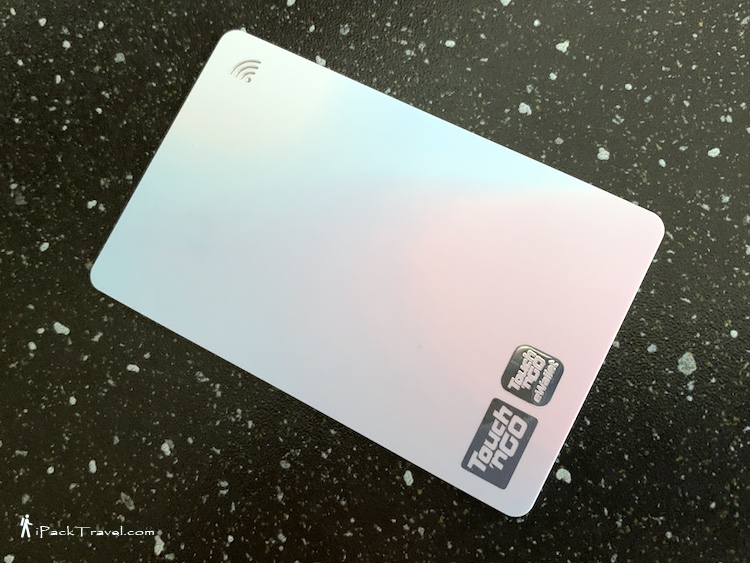
TNG eWallet, downloaded on smart phones, can be used to scan-and-pay at supporting retails, similar to bank payment apps. It can be used to scan both TNG QR codes and DuitNow QR codes. Topping-up the wallet can be done via local banks in Malaysia. For foreigners to Malaysia, or those with no Malaysia bank accounts, topping-up of TNG e-wallets is by means of purchasing TNG Reload PINs, from designated convenience stores and petrol kiosks, or via credit / debit cards with applicable convenience fees (up to 2.6% of top-up amount using foreign-issued cards).
If you register for a TNG eWallet, there is NO need to get a physical TNG card.
More info: Touch n’ Go website
8. ManjaLink Card / ManjaPay E-Wallet
ManjaLink card is a cashless fare card, like Singapore’s EZ-Link card, that can be used to pay for bus fares on Causeway Link services, including BAS.MY public buses (in Johor Bahru and Malacca) and Singapore-Johor cross-border services. It avoids miscommunication with bus drivers and saves the hassle of finding small notes and shillings as no change will be given. For those who travels frequently to Johor Bahru and Malacca, and using Causeway Link’s public bus services, this card is essential.
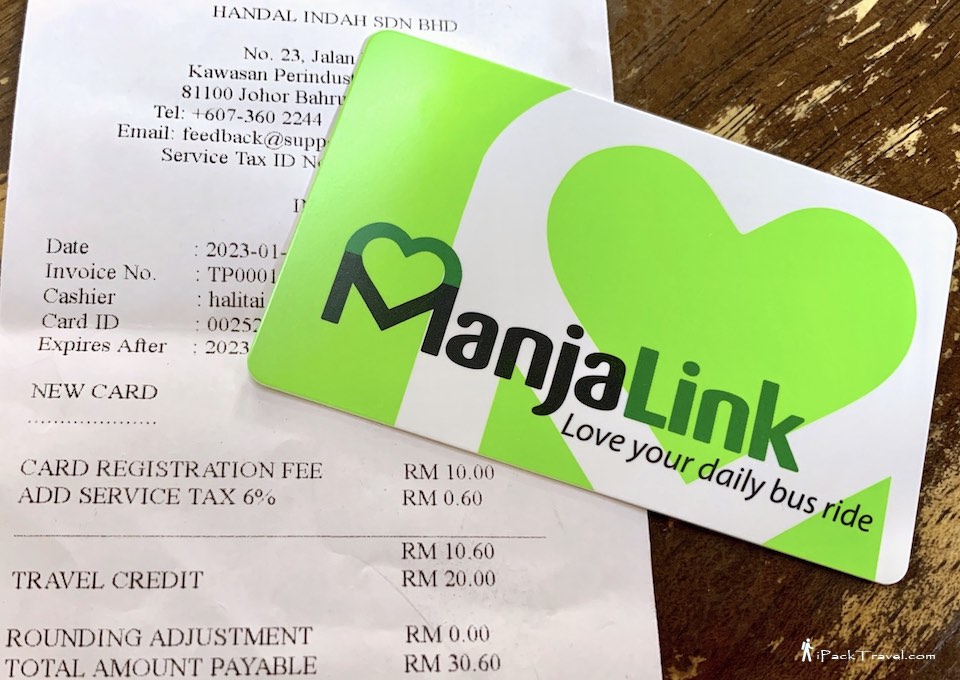
The remaining amount and transaction history of a ManjaLink card can be monitored via LUGO app from authorised app stores. LUGO app also provides a ManjaPay e-wallet that can be used to make fare payments on BAS.MY bus services, but not cross-border bus services. Both ManjaLink card and ManjaPay e-Wallet are two separate entities and the funds in them are non-transferable to one another.
Topping-up of ManjaLink card and ManjaPay eWallet within LUGO is available via Travel Credit Reload Card or BetterPay online payment (via credit/debit card, TNG e-wallet, ShopeePay, etc) — transaction fees may apply for foreign-issued credit cards.
Between ManjaLink card and ManjaPay eWallet, choose one will do. For infrequent travellers, use Visa or Mastercard cards, including YouTrip.
More: Johor Bahru Bus: Cashless Payment on BAS.MY & SG-JB Cross-Border Buses
Summary
On 29 April 2026, the SGD-MYR market rate was around SGD 1 → MYR 3.096 during the day and I made several purchases and top-ups using different methods to find their exchange rates. The exchange rates (some computed) of the above payment methods, in order of best to poor, are as follows:
| Payment Method | Rate (SGD 1 → MYR ?) | Remarks |
| YouTrip | 3.093 | |
| Money Changers (for cash) | 3.075 | In JB CIQ & JB Sentral |
| Touch ‘n Go (top-up via cash) | 3.044 | 1% fee in transferable account |
| Changi Pay (via Alipay+) | 3.040 | I got a discount of S$1.12! |
| Touch ‘n Go (top-up via YouTrip) | 3.031 | 2% fees on YouTrip’s rate |
| DBS Paylah! | 3.0075 | |
| DBS Visa Credit Card | 2.9875 | |
| Touch ‘n Go (top-up via Visa) | 2.909 | Up to 2.6% fees on DBS Visa’s rate |
Notice that:
- Cash does not have the best exchange rate.
- Touch ‘n Go is more cost effective using cash to top-up via Reload PINs.
- Credit cards have the worst exchange rate.
- Topping-up Touch ‘n Go using non-Malaysia-issued credit cards is madness! — I computed the value rather than actually using my credit card.
When travelling in Malaysia, I will carry lesser cash, around S$100 equivalent of Malaysian Ringgit is more than enough as backup. I will use my YouTrip debit card to make payments whenever possible, keeping my credit card as last resort — and “disabled” for overseas use.
I used to use DBS PayLah! for payments out of convenience, but have switched to using Changi Pay (first resort) and Touch ‘n Go eWallet due to their better rates. However, there are times when I have to use DBS PayLah! — when Changi Pay (via Alipay+) is not accepted and both my YouTrip and TNG eWallet have insufficient funds during payment.
Although topping up TNG using cash is more cost-effective, I have to find a money changer or ATM to withdraw cash from YouTrip, then a convenience store to get a Reload PIN to top-up — I rather top it up using YouTrip and pay the 2% fees for convenience.
For smaller vendors, private bus services, etc, that do not accept any methods that technology offers, cash will be used. Of course, my ManjaLink card is for use on public buses only.
In the event my mobile phone runs low on battery or has no connection to the Internet, which happens quite often since foreigners are using roaming data, I will fallback on my YouTrip card and cash.
Next:





Leave a Reply